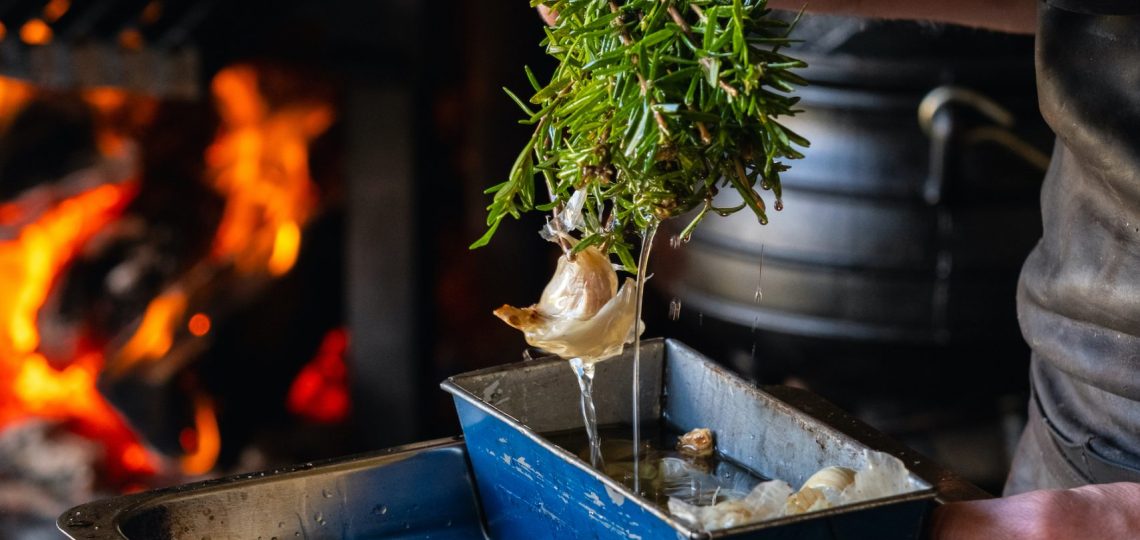
A treasury of wine, elevated rustic food and legendary rugby
Jan “Boland” Coetzee was famous for many things. Springbok rugby player, the winemaker that put Kanonkop on the map, maverick founder of Vriesenhof who smuggled contraband Chardonnay vines from France into South Africa in the early ’80s and changed the course of the country’s wine history… the man lived life fully.
What most don’t know is that at his home on the Vriesenhof estate, he was also a legendary braaimaster, cook and host, not to mention a hunter – and having grown up on the West Coast, an angler, too. The illustrious winemaker could cook a mean coq au vin, and was keen to share some lamb ribbetjies and homemade venison sausage from a hunt with passers-by, as well as his own wines.
In those days, there was no tasting room; there was just Jan and his braai.
Today, his legend lives on at Die Stoep: Vriesenhof’s country restaurant that embodies Coetzee’s laid-back attitude and enthusiasm for simple food cooked well – enjoyed with wine, of course.
With its pared down à la carte menu centred around a wood-fired oven and grill, it’s a place that will be embraced for its simplicity and underlying commitment to the best quality seasonal ingredients. The food offering is a collaboration between proprietor Marc Botes, a seasoned restaurateur and sommelier, and chef Keane Munro.
Centre of good living and rugby
Renovated in 2024 from the framework of Coetzee’s home kitchen, braai and dining area at Vriesenhof – where he lived for over four decades – Die Stoep is one of several offerings that together make this a Stellenbosch treasure with unique identity, a bit of gravitas and easy rustic charm. It is situated high up in the Paradyskloof Valley, with sweeping vistas of vineyards and mountains.
At the entrance to the building is the old-school Vriesenhof tasting room, overseen by its manager and sommelier, Ollie Conradie. He is a man whose knowledge and enthusiasm for the estate’s wines seem boundless, and has passed this on to the tasting room and restaurant teams. It has been Conradie’s labour of love to undertake a massive reorganisation of the basement cellar: three interconnected rooms that house a mind-boggling private collection of vintage Vriesenhof wines, along with priceless bottles from other producers in the industry.
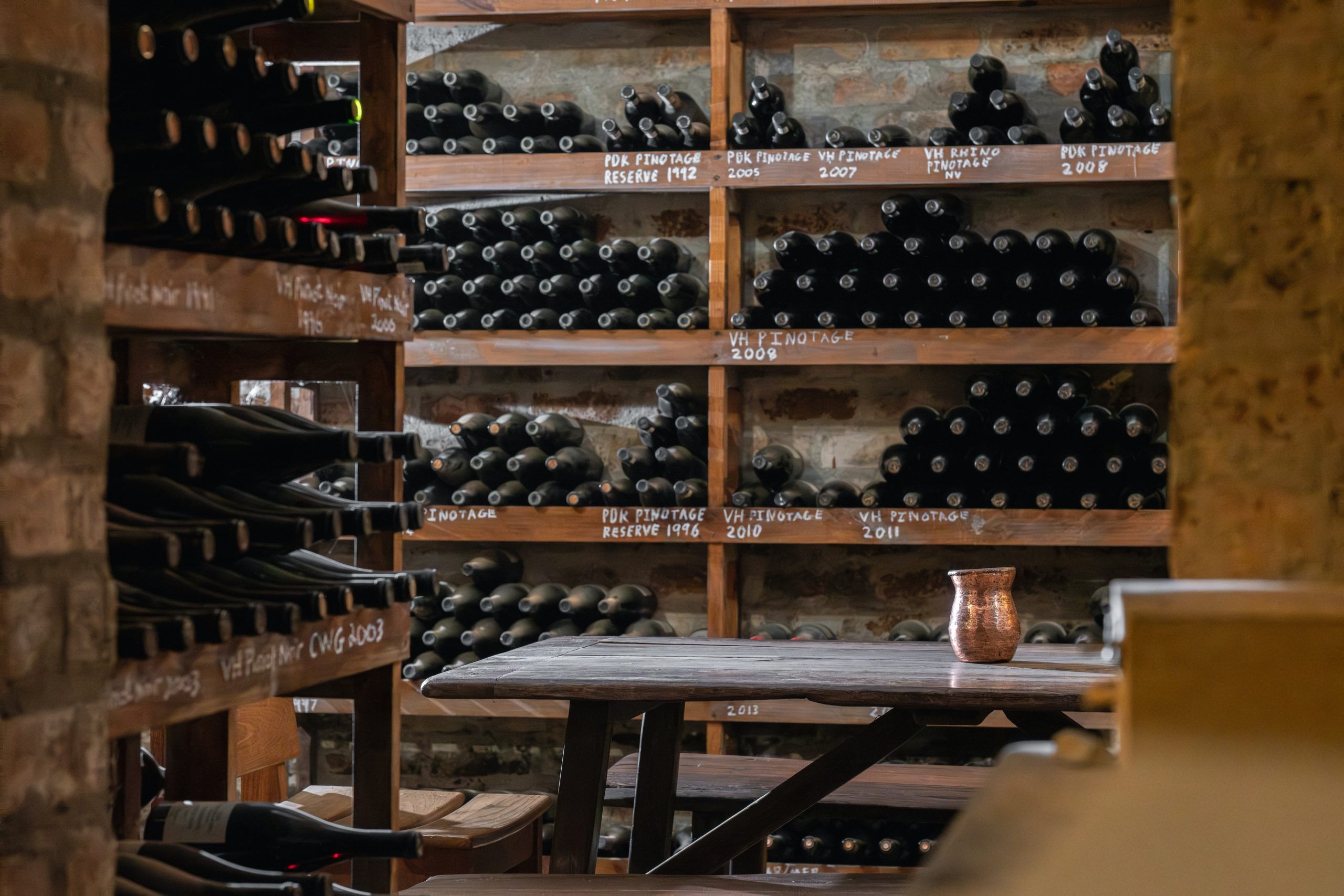
“The wine cellar is a glimpse into the past and a privilege to share with people,” explains Vriesenhof CEO Eddie Smit, who has worked on the farm since 2003 and is a direct link to Coetzee’s legacy. In a generous gesture that would have been characteristic Coetzee, it is open to the public for a peek and a guided meander, and perhaps the occasional treasure to be pulled from the racks and shared.
Some of these wines are available to purchase; others may be cracked open as the mood strikes, and the cellar itself is a unique location for an intimate meal or get-together.
Just as the cellar is a living manifestation of Coetzee’s life, the atmospheric JBC Room (named after Jan) above it tells his remarkable story as rugby icon and formidable winemaker. Its walls are covered with mementos, photographs and panels that bring to life a seemingly unstoppable man, who in his earlier years played professional rugby while working as a winemaker, often pulling 18- to 20-hour days. A co-founder of the Cape Wine Guild, he was a pioneering figure in transforming South Africa’s wine industry with the introduction of French varietals.
The cosy sitting and dining room with fireplace is an extension of the wine tasting room, and can be used for private steak dinners or occasions as well. It should also be a pitstop on the map of every South African rugby lover.
The restaurant: Relaxed mood and elevated rustic food
“At Die Stoep, we want you to feel like you are a guest in someone’s home,” explains Botes, who together with Smit oversaw the considered renovation and is intensely sensitive to the integrity of the property. “We were consciously committed to not changing too much – just enough to make it a little more rustic plush, but not enough to change the mood.”
The Die Stoep concept grew out of wanting to weave together the important influences of Jan’s life: his roots in the land, his time spent in Burgundy doing a vintage, his love of cooking over coals, the simple but perfect act of breaking bread together, and of course wine.
The indoor dining area is cosy and comfortable, simply decorated with a large tiled artwork depicting the Stellenbosch Valley by Coetzee’s son Hendrick – but the real heart of Die Stoep is on the actual stoep. Home to a large wood-fired braai and pizza oven, much of the cooking is done here, particularly in the warmer months. In winter, an indoor open-flamed Spanish Pureruella grill does a superb job. “We cook on coals whenever we can, and always with a direct link to seasonality,” says Botes.
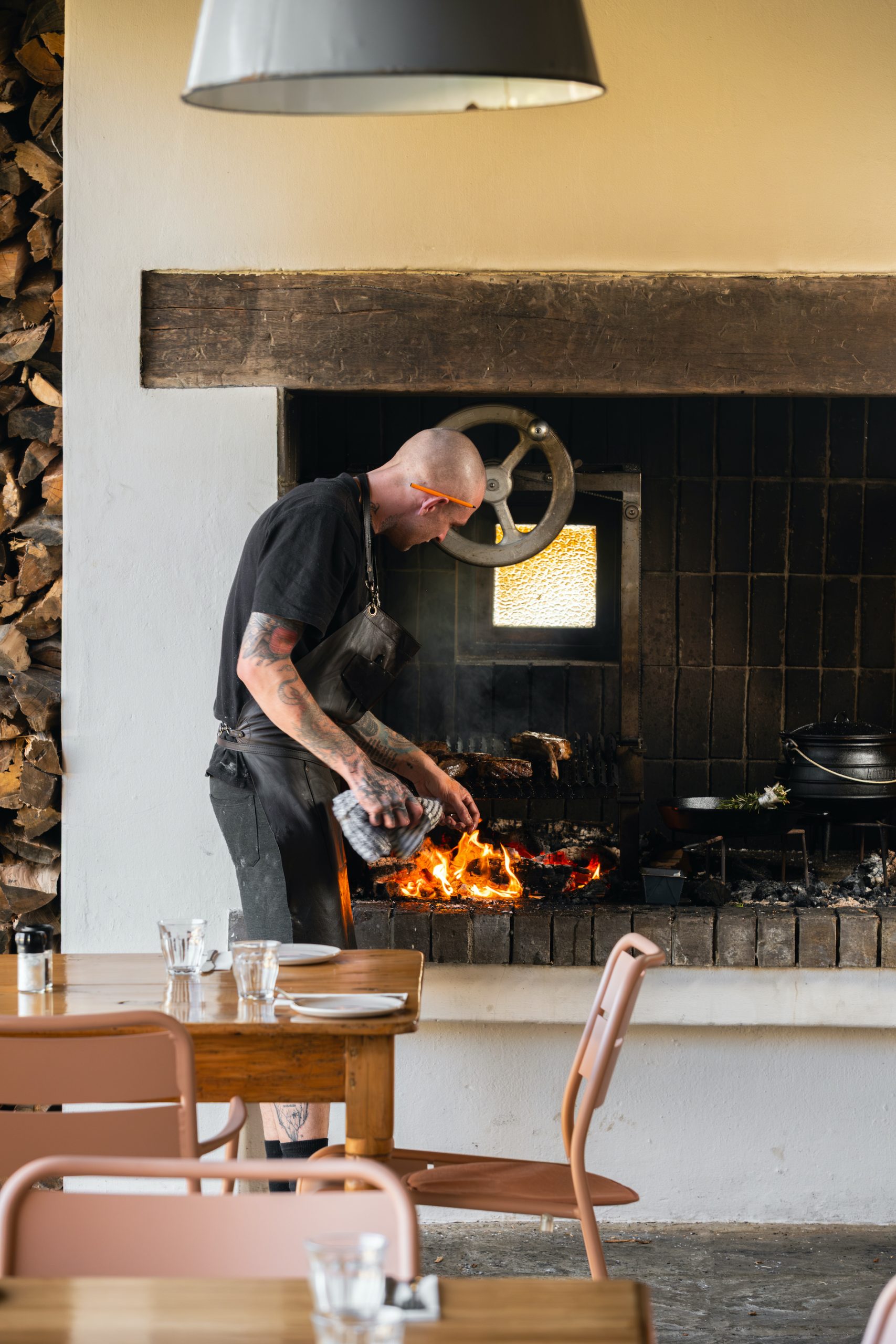
The menu is a collaboration between Botes and Munro. Short and concise, it’s grounded but with a bit of playfulness, and consists mostly of dishes that can be shared: whether cooked with fire, simmered over the stove or simply tossed together with a vinaigrette. It’s a nod to the Mediterranean in style and ingredients, but given a modern South African treatment.
Most importantly, it is not prescriptive: One could load the table with a few snacks and starters to begin, then solo order mains from the grill or pizza oven, and finish off with a couple of shared desserts. Or go traditional starter and main. Or just come for a glass of rosé and a pizza, and see where that leads.
Snacks like a potato pizzette that is a riff on Italian pizzas topped with thinly sliced potato and rosemary; lamb riblets drizzled in apricot and sherry vinaigrette; and crispy artichokes served with tzatziki and garlic crisps. The moreish pork scratchings come hot and crisp to the table, with a smoked paprika-sprinkled mustard aioli; and the kitchen’s homemade sourdough loaf is served with onion ash and miso butters.
A step up in size, the five starters include roasted tomato and red pepper risotto with whipped mascarpone to prawn linefish ravioli with a smoked prawn bisque, and a steak tartare with a cured egg yolk, among others.
Pizzas are made with respect – with a 48-hour sourdough base developed by Botes over the years – and for the toppings, the kitchen pulls from a small but smart selection of high-quality ingredients, including cheese from nearby Puglia Cheese. The classic margherita is made with San Marzano tomatoes, fior di latte, basil and Parmesan; a knock-out anchovy pizza is topped with savoury white anchovy along with olives and capers; and a mushroom pizza bianco is laced with confit garlic, along with mascarpone, fior di latte and rosemary.
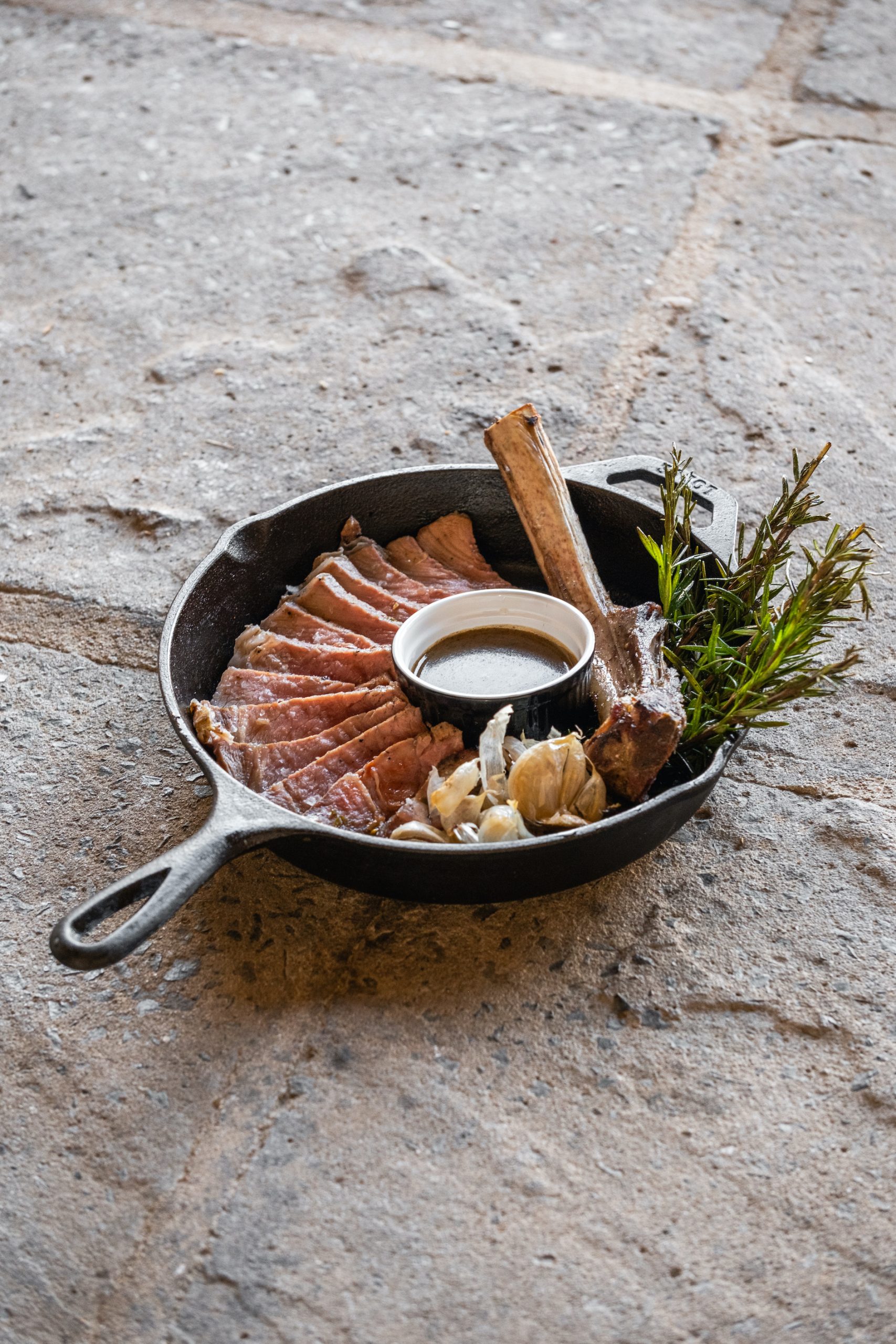
From the wood-fired grills come a selection of four mains: roast pork belly with charred pineapple, red pepper and cucumber; a banger of a grilled sirloin with peppercorn sauce; fire-roasted yellowtail with broken parsley and fermented chilli sauce, atchar and fragrant fennel and coriander; and a grand 850g–900g Côte de Boeuf to share, with bone marrow jus and roasted garlic (pictured below).
Plentiful sides range from hand-cut chips to fired tenderstem broccoli with labneh, coconut and chilli; to an oozy three-cheese mac and cheese, bright with Gruberg, Parmesan, Raclette and prosciutto crumb.
A comforting malva pudding with homemade vanilla bean ice cream is an old-school favourite, but the showstopper is the coal-roasted dark chocolate and orange potjie fondant for two, which is cooked and served in a small potjie pot with melktert (milk tart) ice cream. A generous cheese board is also available.
The Cellar Table Series: Winter regional-themed wine pairing dinners
Coming up this winter is a series of intimate monthly wine dinners, pairing a curated menu with a specific region’s varietals. Each will showcase older vintages and magnums from the cellar, with a focus on Bordeaux (Sauvignon Blanc, Cabernet Sauvignon and Cabernet blends), Burgundy (Chardonnay and Pinot Noir) and Rhône (rosé and Grenache).
Location, location, location
With its position high above the Paradyskloof Valley and neighbouring the Dylan Lewis Sculpture Garden, Vriesenhof is a picture-perfect location, either for a day out in the winelands or a special occasion marked with cocktails and canapes or a sit-down meal.
It boasts a number of areas, indoor and out, which can be used privately for celebrations – including the original pool and pool deck that were part of the house.
As Jan would have liked, it was a house meant to be enjoyed.
Tradition carried forward
“Jan was a man who loved simple things: great wine and good food shared with those he loved, as well as those who would become his friends,” says Smit. “Die Stoep is a place where one gets a sense of that – a place for everyday celebration of the good life. It’s fitting that his warm conviviality lives on for the next generation.”
Die Stoep at Vriesenhof is open:
Tuesday to Thursday: 12h00–16h00
Friday: 12h00–20h30
Saturday to Sunday: 12h00–16h00
Reserve your table online, or telephone +27 (21) 007 5591.
Images credit: Dale Herbst